Work-life imbalance happens when work consistently takes more time and energy than personal life. It affects over 66% of full-time American workers, according to workforce surveys. Left unchecked, it leads to burnout, damaged relationships, and serious physical health problems. Recognizing it early is the first step toward fixing it.
This guide covers the signs of work-life imbalance, its effects on your body and mind, why it happens, and what actually works to correct it.
Signs of Work-Life Imbalance
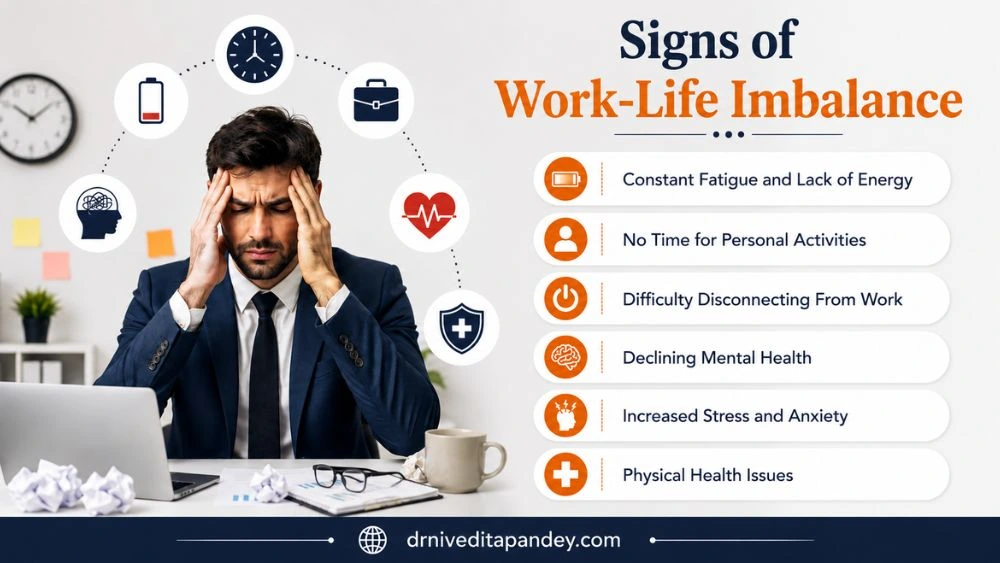
Signs of work-life imbalance often appear gradually. Most people notice something is wrong only after months of operating at an unsustainable pace. The warning signs are specific, not vague.
Constant Fatigue and Lack of Energy
Waking up tired is a key signal. When work consumes your recovery time, your body never fully resets. Sleep quality drops. You start relying on caffeine to function through the day. This isn’t regular tiredness. It’s chronic fatigue (long-term exhaustion that sleep doesn’t fix), and it’s one of the earliest signs of work-life imbalance that gets ignored.
No Time for Personal Activities
Hobbies, family dinners, exercise, and social plans are the first things to go. If you haven’t done something purely for enjoyment in over two weeks, that’s a concrete warning sign. A study published in the Journal of Occupational Health found that workers who consistently skip personal time report 40% higher stress levels than those who protect it.
Difficulty Disconnecting From Work
Checking emails at 10 PM. Thinking about deadlines during dinner. Feeling guilty for taking a break. These behaviors signal that work-life imbalance has crossed into a cognitive (mental) problem, not just a scheduling one. Your brain stays in “work mode” even when the workday is technically over.
Declining Mental Health
Increased irritability, low mood, reduced concentration, and anxiety that spikes on Sunday evenings are all documented signs. These aren’t personality changes. They’re stress responses. When personal recovery time is eliminated, the nervous system stays in a constant alert state, which directly damages mental health over time.
Effects of Poor Work-Life Balance
The effects of poor work-life balance show up physically, professionally, and in your relationships simultaneously.
Burnout From Work-Life Imbalance
Burnout from work-life imbalance is classified by the World Health Organization as an occupational phenomenon (a work-related condition). It’s defined by three things: exhaustion, mental distance from your job, and reduced professional effectiveness. Burnout doesn’t happen overnight. It builds over months and is harder to recover from the longer it goes unaddressed.
Increased Stress and Anxiety
Cortisol (the body’s main stress hormone) stays elevated when there’s no genuine downtime. Chronically high cortisol disrupts sleep, weakens the immune system, and raises blood pressure. Anxiety disorders are significantly more common in people working over 55 hours per week compared to those working standard hours.
Reduced Productivity and Focus
Here’s what most people miss: working more doesn’t mean producing more. Cognitive performance (thinking ability and decision-making) drops sharply after 50 hours of work per week. Errors increase. Creativity falls. You spend more hours producing worse results. The effects of poor work-life balance actively undermine the professional output that justified the overwork in the first place.
Physical Health Issues
Chronic work-life imbalance is linked to a 13% higher risk of coronary heart disease, according to a large-scale European study. Additional documented effects include back pain from prolonged sitting, weight gain from stress eating and skipped exercise, and weakened immunity. These aren’t distant risks. They accumulate with every week of imbalance.
Burnout From Work-Life Imbalance
Burnout from work-life imbalance deserves its own section because it’s commonly misdiagnosed as depression or laziness. It’s neither.
Emotional Exhaustion
Emotional exhaustion means your capacity to care, respond, and engage is depleted. You feel numb toward work that once motivated you. Small tasks feel overwhelming. This isn’t weakness.
It’s a neurological response to sustained overload. Your brain’s prefrontal cortex (the area controlling focus and decision-making) literally functions less efficiently when overworked for extended periods.
Reduced Motivation
Reduced motivation in burnout is different from laziness. Laziness involves not wanting to do something. Burnout involves wanting to but having nothing left to give. People experiencing burnout from work-life imbalance often describe feeling hollow or disconnected, even from things they previously cared about deeply.
Feeling Overwhelmed
When simple tasks like answering an email or making a phone call feel paralyzing, burnout has progressed significantly. This stage requires deliberate intervention, not just a weekend off. Recovery from full burnout typically takes between three and twelve months with active lifestyle changes.
Why Work-Life Imbalance Happens
Work-life imbalance doesn’t happen because people are bad at time management. The causes are structural and psychological.
Remote work blurred the line between home and office. Smartphones made workers reachable at all hours. American workplace culture still treats long hours as a badge of hard work.
Fear of job loss keeps people saying yes to every request. Perfectionism and difficulty delegating amplify the problem further. These forces push toward imbalance even in people who actively want balance.
Time Management Tips for Balance
Time management tips for balance work when they address root causes, not just schedules. Generic advice like “prioritize your tasks” misses the point.
- Time-block your calendar. Assign specific hours to deep work, meetings, and personal time. Protect those blocks the same way you protect client meetings.
- Use the 90-minute rule. Human concentration peaks in 90-minute cycles. Work in focused 90-minute blocks, then take a genuine 15-minute break. This alone improves output quality and reduces mental fatigue.
- Set a hard stop time. Pick a time, say 6 PM, and treat it as non-negotiable. Log off, close your laptop, and step away. Consistent stop times train both your brain and your coworkers.
- Audit your week every Sunday. Look at the past week and identify where personal time was cut. Reschedule those activities into the upcoming week before work fills the space.
- Say no to low-value tasks. Every “yes” to a low-priority task is a “no” to recovery time. Time management tips for balance require protecting your time, not just organizing it.
How to Improve Work-Life Balance
Improving work-life balance starts with accepting that the problem is real and won’t fix itself.
Setting Clear Work Boundaries
Tell your team when you’re unavailable. Set your email auto-responder to reflect realistic response times. Turn off work notifications after your stop time. Boundaries feel uncomfortable at first. They become normal quickly, and most workplaces adjust.
Creating a Structured Daily Routine
A structured routine removes hundreds of small decisions from your day. Wake at the same time, eat at regular intervals, and build personal activities into your schedule the same way you schedule meetings. When routine handles the small stuff, your mental energy stays available for things that actually matter.
Limiting Overtime and Screen Time
Working more than 10 hours of overtime per week is where health risk begins rising measurably. Screen time after 9 PM disrupts melatonin (the sleep hormone) production, which degrades sleep quality. Both limits are concrete and actionable. Improving work-life balance means enforcing these limits even when work pressure pushes back.
Daily Habits That Restore Balance
Small daily habits compound quickly. These are evidence-backed practices that reverse the physiological effects of work-life imbalance.
- Physical movement for 30 minutes daily. diet lowers cortisol, improves sleep quality, and reduces anxiety. It doesn’t need to be intense. Walking counts.
- A no-phone morning routine. Avoid checking your phone for the first 30 minutes after waking. Starting the day without work input protects your mental state from the beginning.
- Social connection. Loneliness accelerates burnout. One meaningful conversation per day, with a friend, family member, or colleague, reduces perceived stress measurably.
- Sleep as a fixed priority. Seven to nine hours isn’t optional for adults. Chronic sleep under six hours produces cognitive impairment equivalent to being legally drunk.
- A clear transition ritual. Create a consistent activity that signals the end of the workday. A walk, a shower, or even changing clothes. Rituals help your nervous system shift out of work mode.
Workplace Strategies to Reduce Imbalance
Individual habits matter, but workplace conditions drive the underlying problem. These strategies work at the organizational level.
- Normalize logging off on time. If leadership leaves at 5:30 PM, the team follows. Culture flows from the top.
- Replace “always available” expectations with clear communication windows. Emergencies aside, most workplace messages don’t require a response within minutes.
- Implement meeting-free blocks. Back-to-back meetings eliminate deep work time and push real work into evenings. Blocking two hours of meeting-free time per day restores that capacity.
- Encourage time-off usage. American workers collectively leave over 700 million vacation days unused per year. Managers who actively encourage time off see lower turnover and higher productivity.
FAQs
What Is Work-Life Imbalance?
Work-life imbalance is a condition where work consistently dominates your time and energy, leaving insufficient space for rest, relationships, and personal activities. The WHO links it directly to burnout, classified as an occupational phenomenon since 2019. It affects over 60% of full-time US workers.
What Are Time Management Tips for Balance?
The most effective time management tips for balance are time-blocking your calendar, setting a fixed daily stop time, doing a weekly time audit every Sunday, and using 90-minute focused work cycles. These address root causes, not just symptoms. Organizing a messy schedule without protecting personal time changes nothing.
Can Work-Life Imbalance Affect Mental Health?
Yes. Work-life imbalance directly causes anxiety, chronic stress, depression symptoms, and burnout. Elevated cortisol from sustained overwork disrupts brain chemistry over time. Workers averaging 55-plus hours weekly show significantly higher rates of anxiety disorder and depressive episodes than those working standard hours.
How to Prevent Work-Life Imbalance?
Set a non-negotiable daily work stop time. Turn off work notifications after hours. Schedule personal activities before work fills your calendar. Audit your weekly hours every Sunday. Work-life imbalance prevention is about protecting personal time proactively, not recovering it after it’s already gone.
When Should I Take a Break From Work?
Take a break every 90 minutes during the workday. Take a full day off weekly without exception. If you’ve skipped more than three personal activities in one week or feel unable to stop thinking about work at night, that’s when a longer break, at minimum a full weekend unplugged, becomes necessary.
How Does Poor Balance Affect Productivity?
The effects of poor work-life balance on productivity are measurable. Cognitive performance drops sharply after 50 work hours per week. Error rates increase. Decision-making slows. Research shows workers logging 55-plus hours weekly produce no more useful output than those working 50, because mental efficiency collapses at that threshold.
About The Author

Medically reviewed by Dr. Nivedita Pandey, MD, DM (Gastroenterology)
Dr. Nivedita Pandey is a U.S.-trained gastroenterologist and hepatologist with extensive experience in diagnosing and treating liver diseases and gastrointestinal disorders. She specializes in liver enzyme abnormalities, fatty liver disease, hepatitis, cirrhosis, and digestive health.
All content is reviewed for medical accuracy and aligned with current clinical guidelines.