A hernia in females happens when tissue or part of an organ pushes through a weak spot in the abdominal wall. You may feel a bulge, pain, or deep pelvic pressure. Some hernias are urgent. Others can wait for the planned repair.
Female Hernia Symptoms:
Women often have different signs than men. Your symptoms may be vague. Pay attention to changes that last or worsen.
Pelvic Or Lower-Abdominal Pain Unique To Women
You may feel dull aching or sharp stabs low in the belly. Pain may come when you stand, cough, or lift. It may get worse with standing, coughing, or lifting. You may feel pressure during exercise.
Pain that rises with activity suggests a problem with the abdominal wall. The pain can stay even when the bulge is not obvious. If pain grows over days or weeks, tell your clinician.
Misdiagnosis As Ovarian Cysts, Fibroids, Or Endometriosis
Your hernia pain or lump may look like gynecologic pain. Doctors may suspect ovarian cysts or endometriosis. Ask for a hernia check if pain links to a groin lump. Clear imaging saves time.
Groin Lump Visibility Differences Due To Anatomy
Women have a different groin shape than men. A hernia may sit deeper and not show as a big bulge. You might only feel pressure or a small lump at the top of the thigh. If a lump appears or changes with strain, seek evaluation.
Worsening Pain During Menstruation Or Pregnancy
Hormone shifts and pregnancy change how you feel pain. Some women notice worse groin pain during their period. Pregnancy also adds pressure inside the belly. This pressure can make a small hernia larger or more painful.
Nausea, Bloating, And Bowel Symptoms Often Mistaken For GI Issues
If bowel enters a hernia sac, you may get nausea, cramps, or bloating. You might think you have a stomach issue. Seek urgent care if vomiting or bowel blockage signs appear. These can mean trapped intestine.
Red Flag Signs (Seek Emergency Care):
- Sudden severe pain at a lump.
- Fever, vomiting, or no bowel movement.
- Tender, hard bulge you cannot push back.
These may signal strangulation. Strangulation stops blood flow to tissue and needs emergency surgery.
Types Of Hernia In Females:
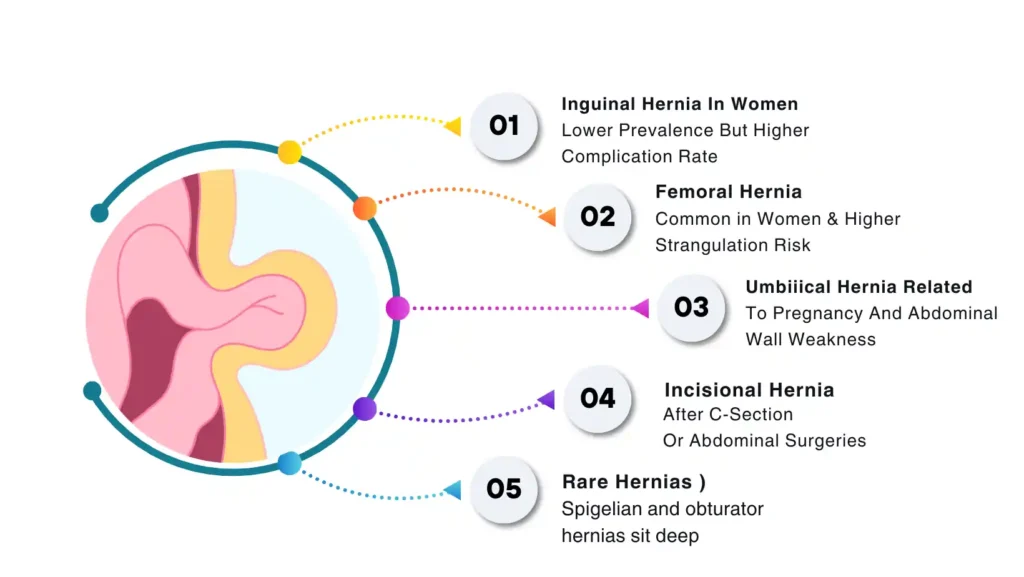
Hernias differ by where they appear. Knowing the type helps choose the right test and treatment.
Inguinal Hernia In Women: Lower Prevalence But Higher Complication Rate
An inguinal hernia appears in the groin near the inguinal canal [a small tunnel that passes near the groin]. Women get these less often than men. When women develop one, doctors sometimes miss it. Delay raises the chance of trapped tissue. For this reason, prompt assessment matters for inguinal hernia in women.
Femoral Hernia: More Common In Women & Higher Strangulation Risk
A femoral hernia appears lower in the groin, near the thigh. It pushes through the femoral canal near the top of the thigh. Women get femoral hernias more often than men. The canal is narrow. This raises the chance the intestine gets trapped.
This type has a higher chance of strangulation. Strangulation means blood flow stops to the trapped tissue. Strangulation causes severe pain and needs urgent surgery. Watch for sudden pain and vomiting. Most femoral hernias need prompt repair.
Umbilical Hernia Related To Pregnancy And Abdominal Wall Weakness
An umbilical hernia shows near your belly button. Pregnancy, weight gain, and repeated childbirth strain the abdominal wall. This strain makes umbilical hernias common in women of childbearing age. Small, painless hernias may be watched. Painful or growing ones often need repair.
Incisional Hernia After C-Section Or Abdominal Surgeries
Surgical cuts can leave weak spots in the abdominal wall. A hernia can form along a scar. If you had a C-section or another abdominal operation, watch for lumps near the scar. Repair planning uses imaging and an exam.
Rare Hernias (Spigelian, Obturator) And How They Present In Women
Spigelian and obturator hernias sit deep. They often cause pain without a large lump. These types can be missed on the exam. Doctors use high-resolution ultrasound, CT, or MRI to find them. If you have unclear groin or pelvic pain, imaging helps.
Hernia Causes In Females:

Hernias form when pressure pushes tissue through a weak spot. In women, several factors raise that risk.
Pregnancy-Related Abdominal Wall Stretching
Pregnancy stretches muscles and connective tissue. The growing uterus pushes the belly walls outward. This strain can open a weak point. Umbilical and incisional hernias are linked to pregnancy and childbirth.
Connective Tissue Weakness Due To Hormonal Influence
Hormones can change collagen and connective tissue strength. Weaker tissue does not hold organs well. Genetics can also make tissue weak. Smokers and those with poor nutrition heal less well. These factors raise your hernia risk.
Chronic Coughing, Constipation, And Heavy Lifting
Anything that raises pressure inside your belly can push tissue out. Chronic cough, straining on the toilet, and heavy lifting are common triggers. Treating cough and constipation reduces risk. Learn safe lifting techniques.
Previous Abdominal Surgeries Increasing Risk
Scars from surgery can weaken the abdominal wall. Incisional hernias may form at these sites. The more surgeries you have, the higher the risk. Talk to your surgeon about scar care after surgery.
Genetic And Lifestyle Contributors In Women
Family history matters. Genes can make you more likely to develop a hernia. High body weight, smoking, and poor nutrition also increase risk. Improving weight and quitting smoking help reduce future hernia chances.
Hernia Treatment For Women
Treatment for a hernia in females depends on how it bothers you and the risk it poses. Some hernias cause no pain. Others grow or trap bowel. If a hernia traps tissue, you need urgent care. Trapped tissue can lose blood flow and die. This condition is called strangulation [when the blood supply to the trapped tissue stops]. You must not ignore new severe pain, nausea, or a lump you cannot push back in.
When Surgery Is Recommended For Female Hernias
You will be offered surgery if the hernia causes pain, gets larger, or traps tissue. Emergency surgery treats trapped bowel or severe pain. Planned surgery suits painful hernias that limit life.
Surgery choices also depend on the hernia type. Femoral hernias often need repair sooner because they can trap tissue. Umbilical hernias that appear after pregnancy often get repaired if they do not shrink. Incisional hernias at scar sites may need a stronger repair because scar tissue can be weak.
Laparoscopic Versus Open Repair For Women
Laparoscopic repair uses small cuts and a thin camera. The camera lets the surgeon see inside. Instruments go through tiny ports. This approach often causes less pain after surgery. You may go home sooner and return to normal work faster. Laparoscopic repair can be a good choice for groin hernias and for women who need repairs on both sides.
Open repair uses a single larger cut at the hernia site. The surgeon works directly on the weak spot. Open repair may suit large or complex hernias. It can also be the safer choice if you have had many prior surgeries. Your surgeon will explain which approach fits your hernia and your health.
Both approaches aim to close the defect and restore the wall. Outcomes depend on surgical skill and the hernia type. Ask your surgeon to explain the plan, the expected recovery, and the likely risks.
Mesh Repair Considerations In Female Patients
Many hernia repairs use mesh to reinforce the repair. A mesh is a woven or synthetic patch placed over or under the weak spot. Mesh lowers the risk that the hernia will return. Most patients tolerate mesh well. Mesh choices vary. Some mesh is permanent. Other types are absorbable over time.
Rarely, mesh can cause chronic pain or local irritation. Your surgeon will explain the best mesh type for your hernia. They will also describe how they place the mesh. Placement can be on top of the muscle, under it, or inside the abdomen. The method influences recovery and outcomes.
If you plan to get pregnant soon, tell your surgeon. A mesh placed near the belly button or lower abdomen may affect surgical choices.
Recovery Expectations And Activity Restrictions
After repair, expect soreness for a few days. You will likely use pain medicine for short periods. You can walk the same day or the next. Avoid lifting heavy loads for the weeks recommended by your surgeon. Return to desk work often takes one to two weeks. Return to physically demanding jobs can take six weeks or more.
You should avoid straining during bowel movements. Use stool softeners if needed. Keep incisions clean and dry. Attend follow-up visits. Report fever, increasing pain, or a growing bulge. These signs need prompt attention.
Risk Of Recurrence And Long-Term Monitoring
A hernia can come back after repair. Recurrence depends on the hernia type, repair method, and patient factors. Smoking and obesity raise recurrence risk. Poor wound healing or infection can also cause recurrence.
Inguinal Hernia In Women
An inguinal hernia in women appears in the groin area near the inguinal canal [a passage for nerves and vessels]. Women get inguinal hernias less often than men. Yet diagnosis in women often takes longer. Delay raises the chance of complications. You should seek evaluation for persistent groin pain or any new lump.
Why Diagnosis Is Often Delayed In Women
Diagnosis is often delayed because symptoms can mimic female pelvic conditions. You may feel pelvic pain that looks like period pain. You may feel discomfort with bowel changes. Doctors may first test for ovarian cysts, fibroids, or endometriosis. If these tests are normal, you should ask about a hernia in Females . A focused groin exam and imaging often find the cause.
Symptoms that mimic gynecologic conditions
Symptoms that mimic gynecologic conditions include pelvic ache, menstrual-like pain, and lower abdominal fullness. You may notice pain during sex or discharge of symptoms with exercise. If you have groin pain that does not match gynecologic findings, your clinician should consider a hernia.
A Higher Risk Of Strangulation Compared To Men
Women face a higher risk of strangulation with groin hernias than men. Strangulation means trapped tissue has no blood supply. It causes sharp pain, vomiting, and a hard bulge. This state needs emergency surgery. Because of this risk, clinicians often favor quicker repair for groin hernias in women.
Importance Of Early Evaluation And Imaging
A careful physical exam while you stand and cough can show a bulge. However, female anatomy and deep tissue can hide it. Imaging helps. Ultrasound is a good first test. It is safe in pregnancy and can detect many hernias. CT or MRI gives clearer views for deep or rare hernias. If a hernia is suspected, imaging helps plan the best surgical approach.
Treatment Urgency And Surgical Options
Treatment urgency depends on symptoms. If the hernia is trapped or painful, you need prompt repair. If the hernia causes mild symptoms, planned laparoscopic repair often gives good results. Laparoscopic repair may reduce post-operative pain and allow faster return to tasks. Open repair remains a valid option for some women. Your surgeon will explain the best choice for your case.
How Hernias Are Diagnosed in Females
Diagnosing a hernia in Females starts with a careful history and hands-on exam. Your clinician will ask when symptoms began and what makes them better or worse. You will be asked to stand, cough, and point to the exact spot of pain. Because female anatomy can hide a lump, the physical exam may not always show the hernia. Your doctor may press gently in different positions to feel any subtle bulge. If the exam is unclear, imaging follows.
Ultrasound is often the first test. It is quick and safe. Ultrasound can show tissue moving through a weak spot. It works well when you can push or cough during the scan. For deep or hidden problems, CT or MRI gives a clearer picture. CT shows bowel and fat in fine detail. MRI helps when soft tissue contrast is needed. If you are pregnant, ultrasound is preferred to avoid radiation.
Differentiating a hernia from ovarian or pelvic disorders requires focused tests. Your provider may order pelvic ultrasound to evaluate ovaries and uterus. If pelvic imaging is normal and pain persists, a targeted groin scan is sensible. Sometimes doctors combine exams. This combined view helps them tell a hernia from an ovarian cyst or fibroid. Clear imaging helps avoid misdiagnosis and speeds correct treatment.
Identifying emergency symptoms is a vital part of diagnosis. If you have sudden severe pain, fever, nausea, or vomiting, you may have a strangulated hernia. A strangulated hernia does not let blood reach the trapped tissue. It causes rapid worsening and needs immediate surgery. If you notice these signs, seek emergency care.
Living With A Hernia As A Woman
Living with a hernia in Females means managing pain, avoiding strain, and knowing warning signs. You can often do light activity safely. Walking helps blood flow and speeds healing after repair. You should avoid pushing or lifting heavy objects. Learn safe lifting mechanics. Bend your knees and keep weight close to your body.
Managing Pain During Daily Activities
Managing pain during daily activities often means using short-term pain medicines as your doctor suggests. A supportive garment may ease discomfort. These garments provide gentle pressure over the weak spot. They do not fix the hernia. Use them for short periods only or when traveling long distances.
Safe Exercise And Core-Strengthening Guidance
Simple exercises taught by a physical therapist can build support without raising intra-abdominal pressure. Your therapist will show you how to activate deep core muscles gently. Avoid intense abdominal exercises until after repair or until cleared by a specialist.
Pregnancy Considerations With An Existing Hernia
Many clinicians delay repair until after delivery unless the hernia causes trouble. If you become pregnant with a known hernia, inform both your OB-GYN and a general surgeon. They will plan monitoring and decide if repair during pregnancy is ever needed. Postpartum repair is common when the hernia causes symptoms.
When Lifestyle Changes Are Not Enough
When lifestyle changes are not enough, surgery becomes the practical choice. If pain limits work, exercise, or sleep, and if the hernia grows, repair improves quality of life. Waiting can raise the chance of complications. Discuss timing and options with your surgeon.
Prevention & Risk Reduction For Female Hernias
You can reduce the chance of developing a hernia in Females . Improving core stability matters. Simple daily posture habits reduce stress on the abdominal wall. Stand straight, tighten your core briefly when lifting, and avoid slouching. Strengthen the deep abdominal muscles with low-pressure exercises.
Managing constipation and chronic cough lowers strain on the belly. Use fiber, water, and stool softeners if needed. Treat chronic cough with medical help and stop smoking. Avoid heavy lifting when possible. If lifting is unavoidable, use your legs and keep the load tight to your body.
Post-surgical strategies to prevent recurrence include following activity limits and wound care instructions. Maintain a healthy weight and quit smoking. Once your surgeon clears you, start guided strengthening to rebuild support. Long-term monitoring of the repair site helps catch early signs of recurrence.
FAQ
Are hernia symptoms different in women?
Yes. Women often have pelvic pain, menstrual-like cramps, or subtle groin discomfort that mimics gynecologic issues. If a lump or bowel change appears with pain, consider a hernia in females.
Can pregnancy cause or worsen a hernia?
Yes. Pregnancy increases belly pressure and stretches the abdominal wall. This can create or worsen an umbilical or incisional hernia. Many repairs wait until after birth unless the hernia is urgent.
Which hernia type is most common in females?
Femoral and inguinal hernias both occur in women. Femoral hernias have higher risk in women. Umbilical hernias are common after pregnancy. Each type needs specific evaluation.
How do doctors diagnose hernias in women?
Doctors use physical exams plus an ultrasound first. CT or MRI follows if the ultrasound is unclear. Imaging helps separate hernias from ovarian or pelvic conditions for accurate care.
Can a hernia be mistaken for menstrual pain?
Yes. Hernia pain can feel like period pain or pelvic discomfort. If pain does not match gynecologic findings or shows a groin lump, ask your doctor about a hernia in females.
Do female hernias always require surgery?
No. Small, painless hernias can be watched with regular exams. Symptomatic or growing hernias and any trapped tissue usually need repair to prevent emergency complications. A hernia in females happens when tissue or part of an organ pushes through a weak spot in the abdominal wall. You may feel a bulge, pain, or deep pelvic pressure. Some hernias are urgent. Others can wait for the planned repair.
About The Author

Medically reviewed by Dr. Nivedita Pandey, MD, DM (Gastroenterology)
Dr. Nivedita Pandey is a U.S.-trained gastroenterologist and hepatologist with extensive experience in diagnosing and treating liver diseases and gastrointestinal disorders. She specializes in liver enzyme abnormalities, fatty liver disease, hepatitis, cirrhosis, and digestive health.
All content is reviewed for medical accuracy and aligned with current clinical guidelines.